
My work at the Open Source Initiative (OSI) has been a front-row seat to a brewing conflict between developers of AI systems and the publishers, creators, and maintainers of the digital commons. The former push the boundaries of what machines can do, de facto expropriating the very people whose work fuels these models.
There has to be a way to tell machines what they can and can’t do with the data they harvest.
The Open Source AI Definition (OSAID) was the first major step in creating a framework to balance power. But as I highlighted in the research for Data Governance for Open Source AI, the OSAID alone doesn’t fix a broken social contract regarding data collected from publicly available sources. We need a way to balance the interests of all stakeholders, from individual content creators to the developers of frontier models, without destroying the commons by creating powerful gatekeepers.
That is the core of my new paper: “The Landscape of Preference Signaling for AI Training“ now available.

Beyond expropriation: The value of intent
The current friction in AI development often stems from a feeling of “take without give.” When AI developers scrape the commons without a mechanism for feedback or alignment with the creators’ values, they risk destroying the very “social good” they claim to build upon.
In the paper, I researched various efforts for Preference Signaling, the technical layer where this social contract can be mended. If we view preferences as a way for the commons to signal its boundaries, ethics, and expertise back to the model, we change the power dynamic.
Aligning with data governance
This work is a direct extension of the research I led at OSI, culminating in the Data Governance for Open Source AI and the data governance conference in 2025. In that study, we identified the massive legal and cultural gap between raw data collection and ethical data stewardship.
By connecting data governance with preference signaling, we can move toward a model where:
- Publishers aren’t just passive data sources; they can actively dictate conditions to use their data.
- AI developers aren’t just “mining” the commons; they participate in a reciprocal loop where models improve with better, consented data.
- The Commons is protected because “signals” prioritize the health of the ecosystem over the optimization of proprietary metrics.
The landscape of reciprocity
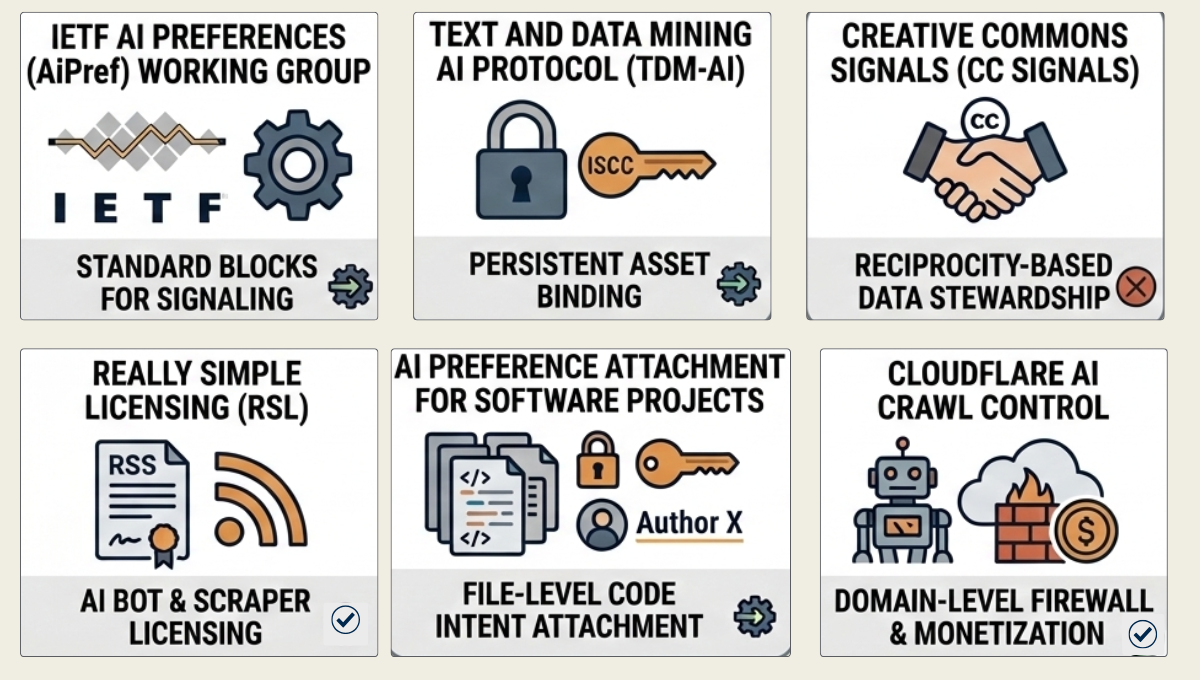
The paper maps out the various efforts that can help to transition from “extractive AI” to “collaborative AI”.
- IETF AI Preferences (AiPref) Working Group: Establishing standard protocols for signaling.
- Text and Data Mining (TDM) AI Protocol: Creating machine-readable rights expressions.
- Creative Commons Signals: Extending the CC legacy into the age of generative models.
- Really Simple Licensing (RSL): Streamlining the legal hurdles for data usage.
- AI Preference Attachment for Software Projects: Giving developers a voice in how their code trains future models.
- Cloudflare AI Crawl Control: Providing technical gates to manage bot behavior at the edge.
We cannot have a healthy Open Source AI, Public AI, open weights ecosystem if the people providing the basic building blocks, the data, feel exploited. At the same time, we cannot afford the risk of giving power to intermediaries that will guard access to the digital commons. By describing the landscape of preference signaling, I hope to provide a map for building AI that respects the labor and intent of the people who maintain the commons.
Read the full paper and join the discussion on how we can turn “expropriation” back into “contribution.”
Acknowledgements
Thanks to Paul Keller, Heather Meeker, and Thom Vaughan for reviewing this article.
Pingback: The license is all you need (for Open Source AI) – ][ Stefano Maffulli