
- The grand illusion of European privacy: GDPR fails the citizens
- Fixing GDPR: The case for a citizen-first privacy dividend
For years, the European Union has proudly positioned itself as the global gold standard for data privacy. The General Data Protection Regulation (GDPR) is routinely celebrated as a monumental shield protecting citizens from the predatory instincts of Big Tech and careless corporations. We are told that in Europe, data is a human right, whereas in the Wild West of the United States, it is merely a commodity.
But as someone who has lived on both sides of the Atlantic, I have come to realize that this EU privacy grand regulatory framework is largely an illusion. When you strip away the bureaucratic self-congratulation and look at the empirical reality of what happens when things go wrong, European citizens are left in no better shape than their unprotected American counterparts. In fact, they might even be worse off.
The reality of the European “Sorry!”
The systemic flaw in the European approach became glaringly obvious to me recently following a massive system breach at Trenitalia, Italy’s primary rail operator. Millions of personal files were exposed, including names, contact details, identity card numbers, and precise travel histories. Because of an incident dating back to late 2025, my personal data is now floating around the dark web, leaving me exposed to targeted phishing campaigns and all sorts of fraud.
What did I, an individual citizen and victim of this breach, receive from Trenitalia? A boilerplate email. A clinical, legally mandated notification that essentially boiled down to an empty “sorry” and an injunction to “be careful” when opening emails.
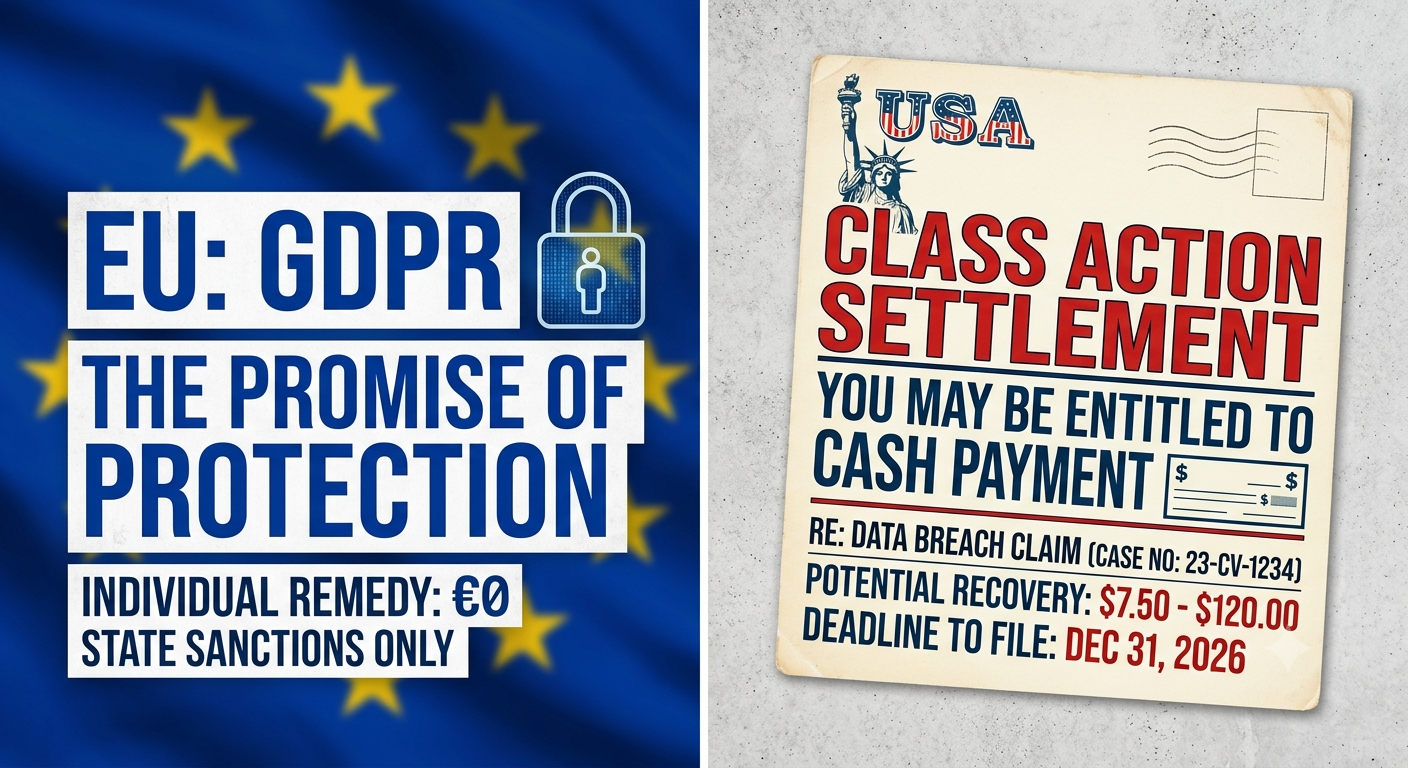
Under GDPR, Trenitalia faces the threat of hefty sanctions from the Italian Privacy Authority (Il Garante). If found negligent, the company may have to pay millions of euros in fines. But here is the catch that European regulators rarely mention: that money goes directly into the state’s coffers. The individual whose privacy was actually violated sees absolutely nothing. The system punishes the corporation to enrich the state, leaving the victim entirely empty-handed.
The American alternative: accountability
Contrast this with the supposedly lawless data landscape of the United States. My data has been leaked multiple times by large American corporations over the years. Yet, the aftermath looked slightly different.
When a major US corporation suffers a breach, the mechanisms of American consumer capitalism and the civil legal system kick into gear to provide immediate, tangible remedies to the affected individuals. In almost every egregious case, I was offered at least some compensation:
- Complimentary credit monitoring: Free, premium credit monitoring and identity theft insurance services for multiple years, paid entirely by the offending company.
- Class-action settlements: The ability to join class-action lawsuits seamlessly. In several instances, this resulted in actual cash payouts delivered straight to my mailbox.
In the US, corporations internalize the cost of their mistakes by paying the victims, not just a government entity. This creates a direct, financial relationship of accountability between the company and the consumer. In Europe, the relationship is strictly between the company and the bureaucrat.
The spam equalizer
Defenders of the European model argue that GDPR at least prevents our data from being weaponized or sold in the first place, reducing the daily friction of data misuse. Empirically, this simply does not hold up.
Despite the endless cookie banners, the mandatory consent checkboxes, and the threat of catastrophic fines, my daily digital experience in Europe is identical to my experience in America. I receive just as many unsolicited spam calls during dinner. My spam folder fills up at the same rate with fraudulent emails. The black market for data thrives just as aggressively in Rome or Paris as it does in New York or Los Angeles, despite the GDPR. Corporations and malicious actors routinely find workarounds, rendering the protective walls of European legislation entirely porous.
Regulating vs. Remedying
Ultimately, the divergence between the EU and US models highlights a fundamental philosophical difference: Europe has focused entirely on regulation, while the US relies on remedy.
GDPR has succeeded in creating a web of administrative compliance that bogs down legitimate businesses with paperwork. It has succeeded in funding government privacy watchdogs threatening massive fine revenues (but not always; ask the people in Abruzzo). But for the citizen standing at the end of the line, the passenger whose passport number was stolen, or the consumer whose phone number is being pinged by scammers, the law in practice provides no comfort, no protection, and no compensation.
When a data breach occurs, an American citizen at least gets a credit monitoring service and a check after a class action lawsuit. A European citizen gets the proverbial kick in the teeth: a cookie banner, a mandatory reading of the privacy policy, and a bureaucratic shrug. Empirically proven, European privacy laws don’t do anything for the citizens they claim to protect. They give a false sense of protection, distracting resources from fixing the root cause.
Read part 2: What a GDPR 2.0 should look like.
Remote Reply
Original Comment URL
Your Profile
Why do I need to enter my profile?
This site is part of the ⁂ open social web, a network of interconnected social platforms (like Mastodon, Pixelfed, Friendica, and others). Unlike centralized social media, your account lives on a platform of your choice, and you can interact with people across different platforms.
By entering your profile, we can send you to your account where you can complete this action.
@stefano Hasn't this typically been the European approach though, and not just for GDPR? 🤔
(I'm from Sweden, and private settlements are far less common than state fines.)
#eu #euvsusa #usa #gdpr #privacy #settlement #legal #individualrights #eupol #uspol
Remote Reply
Original Comment URL
Your Profile
Why do I need to enter my profile?
This site is part of the ⁂ open social web, a network of interconnected social platforms (like Mastodon, Pixelfed, Friendica, and others). Unlike centralized social media, your account lives on a platform of your choice, and you can interact with people across different platforms.
By entering your profile, we can send you to your account where you can complete this action.
@stefano the goal and promise of GDPR is to protect personal data… Not to collect remedies… Presenting remedies as "the promise", is dishonest.
That’s my argument: GDPR fails at protecting personal data. And it fails spectacularly every day in front of our eyes, leaving people harmed and defenseless.
GDPR was a great business opportunity designed in backrooms with little practical container positive effects.
oh wait…
… Yeah, and those useless cookie prompt pop-ups!
Pingback: Fixing GDPR: The case for a citizen-first privacy dividend – ][ Stefano Maffulli