-
Open data won’t tell you who your model is calling

K2 Horizon released everything: weights, data, training code, logs. It may be the largest model to fit the Open Source AI Definition. Great. But does open data make a model trustworthy? Cohere’s Qwen report suggests not. Software earned trust through reproducible builds. LLMs can’t be rebuilt that way, so trust has to come from the…
-
Take copyright out of the AI pipeline
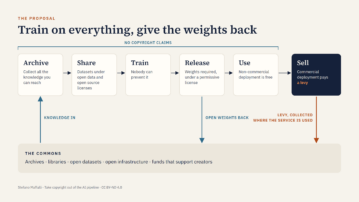
Preference signals can’t restore the balance AI broke. Freeing training from copyright, in exchange for a levy on commercial deployment, can.
-
The license is all you need (for Open Source AI)

Over two years of practice and recent policy decisions prove that the Open Source AI Definition v1.0 is valid. Now let’s focus on the other unresolved issues, like fairness.
-
Fixing GDPR: The case for a citizen-first privacy dividend

Europe’s GDPR successfully punishes corporate negligence, but it leaves the actual victims of data breaches empty-handed. To truly protect citizens, a reformed “GDPR 2.0” must mandate direct financial remediation. Turning personal data into a clear balance-sheet liability will finally force companies to stop hoarding data and eliminate predatory spam.
-
The grand illusion of European privacy: GDPR fails the citizens

EU data privacy laws claim to shield citizens, but a recent Trenitalia breach proves otherwise: victims get empty apologies while states collect the fines. In the US, class actions and free credit monitoring offer real remedy. GDPR is just a distraction.
Open source, business, marketing, community
![][ Stefano Maffulli](https://www.maffulli.net/wp-content/uploads/2020/12/cropped-yr4r1wl0rjs-scaled-1.jpg)