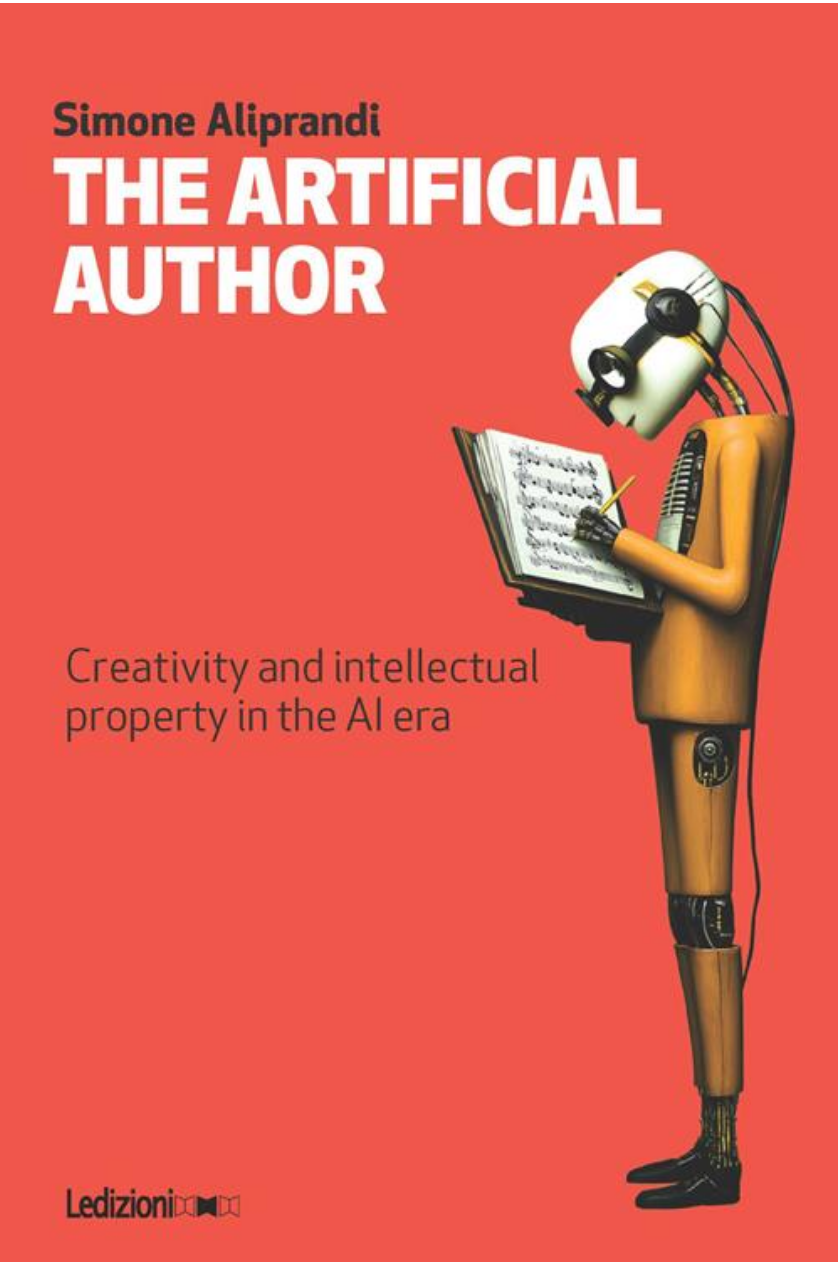

In The Artificial Author, Italian lawyer and researcher Simone Aliprandi tackles the collision of generative artificial intelligence with the centuries-old framework of copyright law. Published in late 2025, the book arrives at a critical juncture where the hype of AI is settling into a complex reality of litigation, regulation, and existential questioning. Aliprandi, a veteran of the open culture movement (and a personal friend), brings academic sobriety to a debate often polarized between techno-utopianism and reactionary fear.
Aliprandi’s inquiry revolves around the meaning of the word “author.” As AI systems evolve from mere tools into entities capable of generating autonomous output, the book challenges the anthropocentric foundations of intellectual property. Following examples from past innovation, Aliprandi does not merely ask if a machine can be an author, but rather what happens to the human role when creativity becomes a curatorial act of “controlling outputs” rather than artisanal execution. This distinction is vital for understanding the current legal landscape, which Aliprandi dissects with the precision of a practitioner. He navigates the ongoing litigations, primarily focused on the use of copyrighted works for training datasets, providing a schematic analysis of the ongoing judicial cases in Europe and the US.
The book is particularly poignant when addressing the cultural friction accompanying AI development. We are currently witnessing a surge in what some critics describe as “neo-luddism”: a visceral, cultural pushback from the creative class fearing displacement and devaluation. While Aliprandi approaches this not as a political commentator but as a legal scholar, his analysis of the training phase of AI models strikes at the heart of these grievances. By exploring how massive scraping of human creativity fuels these models, he validates the legal complexity behind the artists’ outrage while likely steering the reader toward solutions that balance innovation with fair remuneration and attribution, consistent with his background in open licensing.
Crucially for me, The Artificial Author fits alongside the work I led at the Open Source Initiative (OSI). Aliprandi’s long-standing engagement with the open ecosystem makes his perspective highly relevant to the OSI’s efforts to define “Open Source AI.” The OSI has struggled to adapt the four freedoms of software (use, study, modify, share) to neural networks, where “source code” is neither training data nor weights alone. Aliprandi’s book implicitly deals with this challenge, suggesting that for AI to be truly “open” or “democratic,” we must resolve the legal status of both the input (data) and the output (synthetic media). His work implies that without a clear legal framework that respects the “commons,” the Open Source AI movement risks being stifled by proprietary black boxes or bogged down by infinite litigation.
The Artificial Author (paperback and ebook) is a wide and deep analysis of the role of copyright in Europe and the US for generative AI, from training to the generated output. Aliprandi avoids declaring copyright dead; instead, he argues for its necessary evolution.