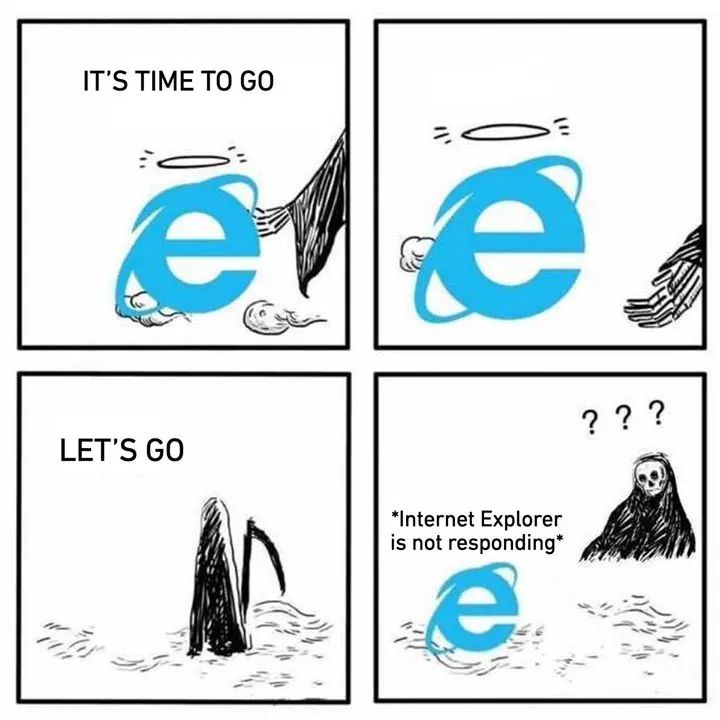

Along with a rag-tag group of true believers, I fought Microsoft. In the early 2000s, we took them on in a battle for the open web in retaliation for their predatory practices. Internet Explorer was Microsoft’s Trojan horse, with the goal of enslaving the web while the rest of the world blithely surfed around the Internet World exposition.
You would think I’d be happy that IE is finally dying.
OMG… pic.twitter.com/tQ9QKPVQqb
— Chris Heilmann (@codepo8) August 24, 2020
But I’m not popping that jig just yet. The death of this 25-year-old browser shoves us one step closer to a monoculture, with two or three big corporations owning our digital life.
The open web has been under assault since the 90s. Internet Explorer tore into the open standards set by the WorldWideWeb Consortium (W3C) and Outlook multiplied threats to email standards set by the Internet Engineering Task Force (IETF). Not by chance these attacks were marshaled by the same company: Microsoft. Accused and sanctioned for abuse of dominant position by antitrust agencies in the US and EU, the Microsoft of that era believed it could embrace, extend and extinguish the internet.
Internet Explorer was a horrible piece of software, crawling with bugs, badly following open standards. But it shipped by default in nearly every computer sold. (At the time, Apple was clawing its way out of a deep trough). It came with its own proprietary scripting language, VBScript and ActiveX, which were were only available on Windows and IE. Many early forays into government websites and home-banking systems relied on ActiveX and VBScript.
Because nobody gets fired for choosing Microsoft, a huge chunk of the world did. And IE was the gateway into lots of data centers. Microsoft’s pitch was effective: Do you want your home banking site to work smoothly with 90% of computers? Buy a Windows Server, it comes with ActiveX and all the other bells and whistles, for free. This is why the digital-first nation of South Korea is forced to shop with Windows and IE. Microsoft even pushed its homegrown alternative to Adobe’s Flash, Silverlight. They used heavy artillery to destroy competitors.
The European Commission understood the digital land grab and hauled Microsoft to court. Years passed, but thanks to the support of Free Software Foundation Europe (of which I was Italian Chancellor at the time), the Samba Team, Novell, Sun and many others, the Commission won. After the largest fine ever slapped on a company by the EC, Microsoft was put under scrutiny. Forced to release its standards and protocols under permissive copyright and patent licenses, the world finally enjoyed some interoperability with enterprise software like Active Directory, Active Sync, SMB/CIFS and MS Office files. Additionally, every personal computer sold in Europe with Microsoft Windows had to offer more than one browser. The optimistic name? “Browser Choice Initiative.”
The thing is, antitrust trials don’t move at the speed of the internet.
Novell filed its first complaint to the EC in 1993. Sun filed another in 1998. Slog forward to the first sentence against Microsoft: 2004. The record €899-million fine was confirmed only in 2012, practically dog years in the tech world. As the courts dragged on, Microsoft managed to kill its main competitor in the web space: the Netscape browser. Then the Netscape Corp resurrected into the Mozilla Corporation and Mozilla Foundation, open sourcing a plethora with the Firefox browser and the email client Thunderbird. Mozilla led the way to the open web.
I’m the first to admit the Browser Choice initiative didn’t change much, as expected. At least consumers had an idea there was an alternative to Microsoft as they auto-clicked on IE. Then Google entered the arena with its own browser in 2008.
We thought open source won. The rush of victory didn’t last long.
Chrome’s roots derive from open source KDE project KHTML. Apple forked it to develop WebKit, a piece of which was later forked by Google to develop Chrome. Chrome itself is not open source. Chromium, its sibling, is open source. Today Microsoft and Google appear to play nice together with Chromium. How long will this truce last?
The Chromium codebase is licensed to allow either party to modify the code and not give it back to the other. They’re competitors. And for both companies, in the context of the browser, we, the people, are the products.
With Chrome/Chromium laying claim to 70% of market share, destined to grow with Microsoft backing it up, why bother adopting and enforcing standards set by industry consortiums? What will prevent Google from making Chrome work better with Gmail and Google Docs while Microsoft focuses on IE’s replacement, Edge to work better with Office365? Once all alternatives are wiped out like Netscape, there will be no obstacles to embedding all sorts of online trackers, DRM and proprietary extensions. The W3C will cede the last grain of independence it has and the web will be finally owned by two U.S. corporations. Conversations of net neutrality will lose importance because control will move up the stack.
A duopoly in the making
We’re already seeing the effects of monoculture and disproportionate control in mobile app stores. Only two companies (Apple and Google) own the toll booths to access people’s mobile devices. And they are exercising their power to block competitors and extort high fees to developers. By handing the web to only two companies we’re opening the path to a dangerous duopoly.
Many pixels have been shared over how open source runs the world these days. Heed my words: Open source is not winning; I said back in 2012 that Linux simply won against the proprietary Unix. The large corporations are winning, with the old tactics of embrace and extend. They just put a veneer of openness on top.
Unfortunately the death of IE won’t make Mozilla stronger nor boost marketshare to alternatives like DuckDuckGo. Today, a strong Firefox is more important than ever. Hopefully the team can focus on delivering the best privacy-focused browser experience and gain adoption — even winning over zombie users still browsing with IE would bump their market share over Edge.
But I have no illusions: The courts will have to intervene to settle this one, too. Instead of celebrating the demise of IE, now’s the time to start talking to your political representatives, educate them for the antitrust trials to come.
Interesting post, you should consider talking also about the right to access, as browsers can prevent you from downloading software. And they do that.
Very good point. It’s a topic worth another post, goes together with the API changes in Chrome that prevent ad blockers
Great. Let me know if you need any help with that, happy to share an historical perspective on the whole thing, starting with the ‘Safe browsing’ initiative back in 2017.
This Article was mentioned on brid-gy.appspot.com
Do you believe open source runs the world these days? Heed my words: Open source is not winning; I said back in 2012 that Linux simply won a
No mention/comment on DuckDuckGo?
This Article was mentioned on brid-gy.appspot.com
DDG is mentioned at the end and I believe it deserves its own post, too. I’m working on one dedicated to the search space
I should be a more thorough and critical reader. Apologies for that. I do believe DDG and other privacy-oriented search engines have a shot at taking steam out of Google.
Honestly, I don’t think they have any chance at taking steam off of G without legislative intervention. I’ve seen the movie already 🙂 But that intervention is a possibility.
Today Microsoft and Google appear to play nice together with Chromium. How long will this truce last? maffulli.net/2020/12/18/int… #openweb #chro
Today Microsoft and Google appear to play nice together with Chromium. How long will this truce last? maffulli.net/2020/12/18/int… #openweb #chro
Long live the @firefox browser. Now more than ever
Another reason not to be happy about the Chrom* monopoly.
Use @firefox
maffulli.net/2020/12/18/int… twitter.com/spotfoss/statu…
Another reason not to be happy about the Chrom* monopoly.
Use @firefox
maffulli.net/2020/12/18/int… twitter.com/spotfoss/statu…
Pingback: New #OSI chief (facepalm a bit) https://www.maffulli.net/2020/12/18/int… | Dr. Roy Schestowitz (罗伊)
Pingback: Techrights Statement on Stefano Maffulli as Executive Director of OSI | Techrights