
Creative Commons spent a year building AI preference signals on the logic of its licenses, then stopped in April. By September CC was explaining why. In its workshops, AI lab representatives had said they might treat any “yes, if…” as a blanket “no.” CC also said in public what I’ve been arguing since 2024: copyright is the wrong tool for governing AI. The free and open source movement, and later CC, built a sharing culture on copyright, and it worked. At the scale of AI training, copyright breaks.
CC’s new work still carries the Signals name, but it’s a different project. The organization built on licenses has conceded that licenses can’t fix AI, and the rest of us should listen.
The other proposals hit the wall CC hit first: a signal can’t enforce anything once the data leaves the server. The IETF AI Preferences working group is the backbone for all of them. It offers a shared vocabulary (train-ai, search, and now ai-use), a Content-Usage header, and a rule that the most restrictive preference wins. Yet its latest vocabulary draft says the spec neither ensures anyone follows preferences nor addresses when they should. Its August deadline slipped.
TDM-AI fingerprints individual works and links them to rights holders. Really Simple Licensing wants payment and collective bargaining, Cloudflare a toll booth in front of the server, CodeCommons preferences written into source files. Each tells a crawler what the rights holder wants. None of them controls what happens next.
Meanwhile the commons is closing. Terms of service restrict crawling for 45% of C4, a dataset researchers use well beyond AI.
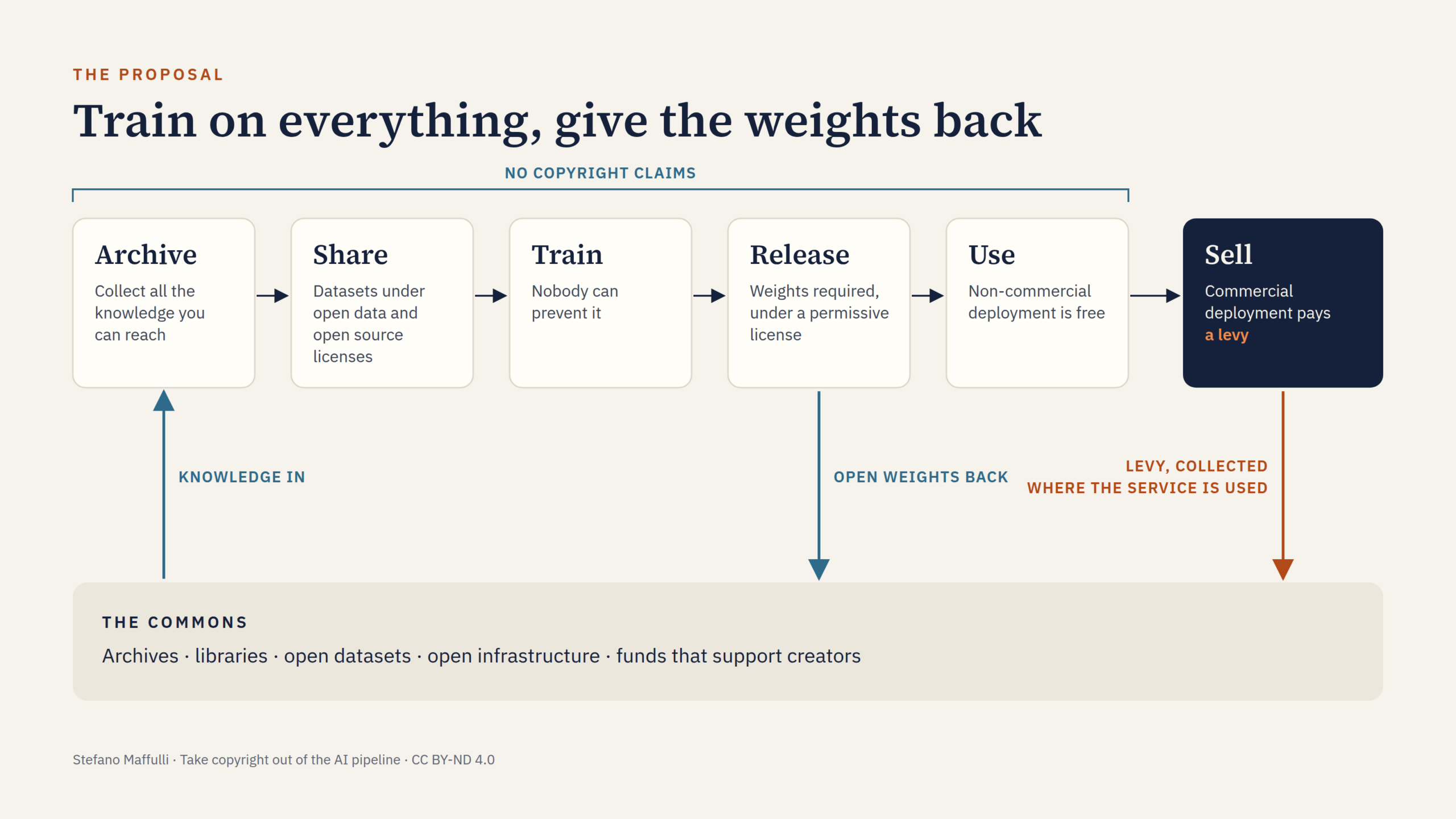
My proposal: stop asking copyright to do this job. Take training out of copyright, in exchange for a levy on commercial deployment, and require the trained weights to come back to the commons.
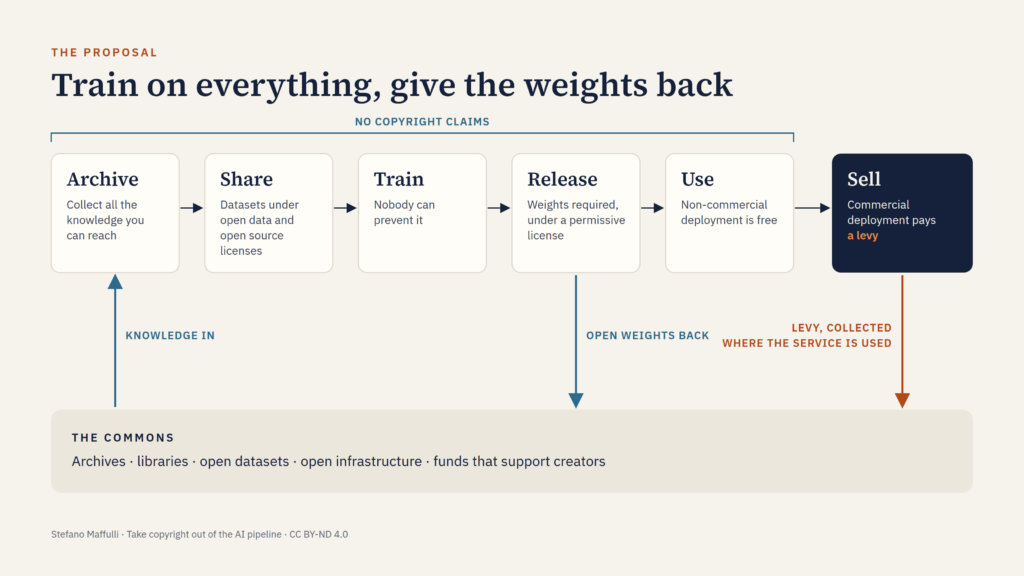
Scrapers, aggregators and researchers should be able to archive all the knowledge they can reach, and terms of service shouldn’t be able to undo that. Datasets should circulate under open data and open source licenses, free of author-by-author claims. Nobody should be able to prevent training, and non-commercial deployments should face no copyright obstacles. In return, every model trained this way should have its weights released under a permissive license. Removing copyright from the input widens the commons, and the weights flow back into it. Train on everything, give the weights back.
Companies would pay when they take a model to market: a levy on commercial deployments, collected in the country where people use the service, not where the company keeps its headquarters. Archiving, research and training would stay untaxed, so the burden falls on commercial exploitation.
The money would go back to the commons: archives, libraries, open datasets, open infrastructure, cultural funds that support creators. I’d keep it away from traditional collecting societies, whose record of paying individual creators is poor. Open Future’s “Beyond AI and Copyright” proposal points in a similar direction, and CC called it worth considering.
None of the pieces is new. The Cyber Resilience Act drew a line between commercial activity and non-commercial open source, and lawmakers argued over it until it held. Private copying levies compensate creators without asking permission for each copy. Digital services taxes collect revenue where the users are.
Brussels has started reworking EU copyright rules, too. On September 29, the Commission opened a consultation that covers the use of protected content in AI.
I expect four objections to this proposal.
“This throws away consent.” Consent through copyright was never real for individuals (listen to Professor Pam Samuelson). Even CC Signals was designed for data stewards, the archives, libraries and cooperatives that hold large collections, not for individual creators. Copyright consent works for large aggregators who can negotiate, and almost nobody else. Compensation that reaches society beats consent that doesn’t.
“What counts as commercial?” Freemium tiers, internal enterprise use, a startup serving open weights behind a paid API: the edges are hard. The CRA faced edges just like these and still landed on a workable line.
“Big tech keeps its private user data.” True. The proposal levels access to public knowledge and leaves that advantage intact.
“What about personal data?” Removing copyright from the pipeline doesn’t remove data protection law. GDPR still applies to every scraper and every archive.
Hardware and skills cost money and time; data is where the rules tilt the field. In a copyright-constrained world, only companies with capital can sign deals with book and music publishers, Getty Images and the other large aggregators. Open source AI developers start behind and stay there. Take training out of copyright, charge a levy on commercial use, and open source developers and big tech train on the same body of human knowledge, while commercial success pays society back.
The balance that held the early Internet together cracked with Web 2.0 and the emergence of big tech; AI finished the job. We won’t rebuild it one robots.txt line at a time. The CRA showed that Europe can write rules that protect open source and put the burden on commercial exploitation. Let’s do it again for AI, starting with our answers to the Commission before the November 3 deadline.
You must be logged in to post a comment.