-
Wow! Talk about a bold position to take. What do you think? Is Open Source riskier now? https://www.spiceworks.com/security/why-ai-makes-your-open-source-stack-riskier-than-ever/ #OpenSource #Security
-
Back from #MozFest in Barcelona. One of the workshops addressed the (lack of) data regarding the data centers currently being built, as well as demonstrating an open data mapping solution. The tone of the entire presentation was quite combative—essentially taking an “anti-data center” stance—with a strong focus on opposing AI; the sentiment was that nobody wants these facilities, especially given the general dislike for figures like Altman, Musk, and the rest of that tech-oligarch crowd. Fair enough, everyone can agree on that.
But I had to ask: “Are you aware that there is an EU mandate to repatriate data and applications currently running on AWS, Azure, and others? So, do we need new data centers in Europe or not?” The room fell silent. It’s easy to advocate against massive, multi-megawatt data centers, but all of them? Where are we supposed to store our photos and emails? What’s the alternative?
-
The analogy source:binary = data:weights is as attractive as it’s misleading. Source and binary are the same artifact of human intellect: one suitable for consumption by human, while the other is the same thing suitable for machine interpretation. One can derive from the other. Legally, they’re also considered the same thing. The training dataset and weights aren’t the same thing viewed from a different angle, neither technically nor from the legal standpoint.
I still see people from open source communities online repeating this argument: spreading will only lead to bad policies.
-
“We Permit the Use of AI, but […]”: The Landscape of AI Policies in Popular Open Source Projects – 2609.07542v1.pdf
Small dataset, but …
we found that a large majority of policies, 83.3%, permit or encourage AI use in code contributions. However, it is
important noting that permission comes with conditions: 67.3% require a high level of human involvement, 48.8% require disclosure of AI usage, and 43.4% assign accountability to the human contributor.
-
`the issue isn’t even that the research is sketchy (although… it is). Nor is it that the research was paid for by an interested party (though… it was). The main issue is that the funding appears to have been deliberately hidden from the defendants, and then the sketchy, paid-for research was laundered into the case through a different expert after the deadline for expert reports had passed.`
-
That will change with the Cyber Resilience Act #CRA: Apple is the manufacturer and will have to take ownership and responsibility for all the software it ships, including Curl. Unless you plan on Curl to have an open source “steward” but I doubt that makes sense for you. Have you already decided your CRA strategy?
#CRAFediverse Reactions
-
-
This table from @Mozilla’s State of Open Source AI v1.1 shows that the weights’ license is the single most important factor in the Open Source AI debate. Proof? Read how Thomson Reuters created Thomson (TLDR: Qwen > Snowdon > Thomson).
As I said: The license is all you need.
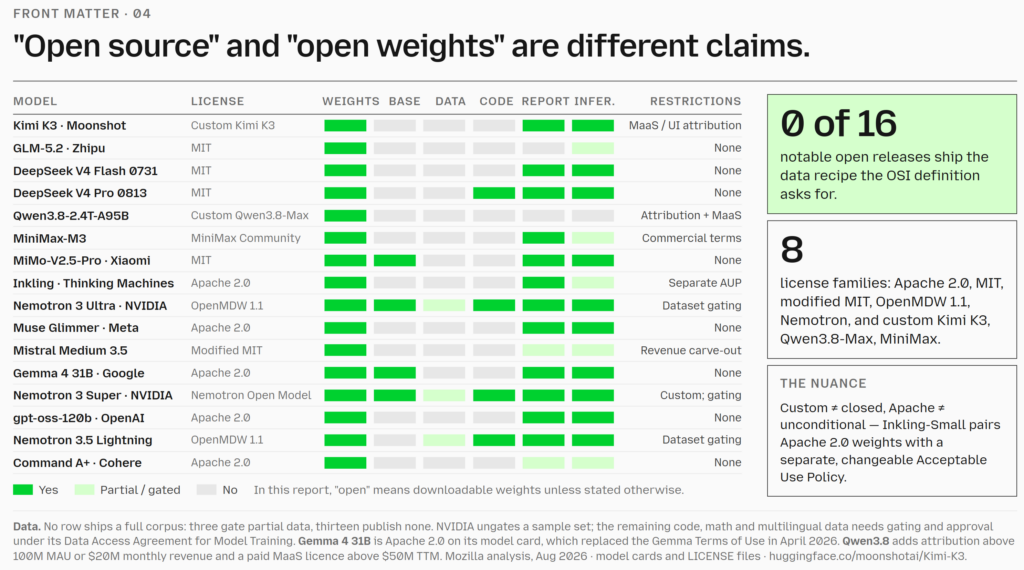
From Mozilla State Of Open Source AI v1.1, September 2026.
-
True, upgrades and migrations between versions are common across all kinds. My article refers to the *added* costs of open source solutions. Many people still think that because someone publishes software with an open source license, that software is free as in beer. It’s not. It’s more like a puppy: you’ll have the responsibility to care for it.
PS testing a reply to a Mastodon post from my ActivityPub-enabled blog. Let’s see if it works.
-
Stop saying “open source sustainability” | Grist
The words “open source sustainability” seem to imply that the whole open source ecosystem has a systemic problem. Even the European Commission mentions “sustainability” as a generic issue of “open source“ in its “Open Source Strategy” document. Lumping together behemoth projects like Kubernetes with VLC and XZ Util is a mistake that confuses users and customers: the differences cannot be ignored.
Source: Stop saying “open source sustainability” | Grist (by me)
-
Open weights are not open source: Why AI’s favorite label is under dispute
Downloading a model is increasingly easy. Understanding how it was made, or changing a system at its root, is another matter
Source: Open weights are not open source: Why AI’s favorite label is under dispute
And yet, the critics of the Open Source AI Definition haven’t yet been able to propose any alternative that is practical, usable, or used in practice. Meanwhile, the AI policies are clearly showing that this debate on the training data is largely settled, and what matters are the individual pieces that build the LLMs and the individual licenses.
It’s easy to stand back and preach, but the world is moving rapidly past the saint and its self-proclaimed bishops.
Fediverse Reactions
-
Open source, business, marketing, community
![][ Stefano Maffulli](https://www.maffulli.net/wp-content/uploads/2020/12/cropped-yr4r1wl0rjs-scaled-1.jpg)





You must be logged in to post a comment.