
Richard Stallman and the FSF apologized for their actions. Good. Now they need to recover for a generation lost behind a world that doesn’t matter anymore. Free/libre software is at a crossroads: What are the four freedoms for these days? How do you apply freedom in the modern technological landscape? It’s time to have a conversation about who the ‘users’ of ‘computers’ are. Without a modern definition of who the users are, the mission of the Free Software Foundation can’t be judged and looks obsolete.
The FSF is “a nonprofit with a worldwide mission to promote computer user freedom” established in 1985 by Richard Stallman. At the time, computers were becoming “personal,” transitioning from the enormous machines, so expensive and complicated that only a few universities and corporations could afford them. The early leaders of the free software movement formed their minds with the idea that computer users were hackers, programmers, scientists and others like them. Fast forward 40 years and that world has turned completely upside down.
Who were the computer users in the 80s
Today’s definition of computer is not that different from that of the late 70s: it’s a general purpose programmable machine that can do a lot of stuff. The person using such a machine, however, has changed quite a bit in the intervening generation. And the machine itself has taken on a lot of new forms, too.
While in the 80s computers became “personal”, and were cheaper and easier to use than in the 70s, you still needed to read a manual before achieving anything useful. Today, you can buy a computer for less then $100, billions of people have supercomputers in their pockets and if you have to read a manual to use software, there is something wrong.
Billions more people use computers today than in 1985. These new “users” are nothing like the users that the Free Software Foundation’s founders had in mind when they wrote the GNU Manifesto.
Over the years, through conversations that I had with Stallman and reading his writings, it’s clear to me that in defining free software, he equates users to programmers. Acknowledging that not everyone can or wants to be a programmer, he asserts that people can hire programmers.
The equation user == programmer creates a first layer of confusion for the importance of free (as in freedom) software in the 21st century. I believe the discussions about ethical licenses and those about shared source, cloud-defensive licenses are (at least partially) created by the lack of definition for users.
What’s missing from the definition of Free Software
The Free Software Definition talks about users but doesn’t define the term:
the users (both individually and collectively) control the program and what it does for them.[…]
A program is free software if it gives users adequately all of these freedoms.
But it makes a distinction between developers and users. For example:
The nonfree program controls the users, and the developer controls the program[…]
[…]it is the user’s purpose that matters, not the developer’s purpose
The concept of user is clear when sitting in front of your laptop opening a file saved on your hard disk using a local application. The developer is whoever wrote the code for LibreOffice that interprets your document, the user is you. Remove the freedom to give a copy of LibreOffice to your friends and you have limited their capability to access the document you produced.
Clear enough, right?
Now move that document to something simple in the cloud. Take a document editing software delivered as Software-as-a-Service (SaaS), like Etherpad. You have clients in form of web browsers connecting to a server, as in the diagram below:
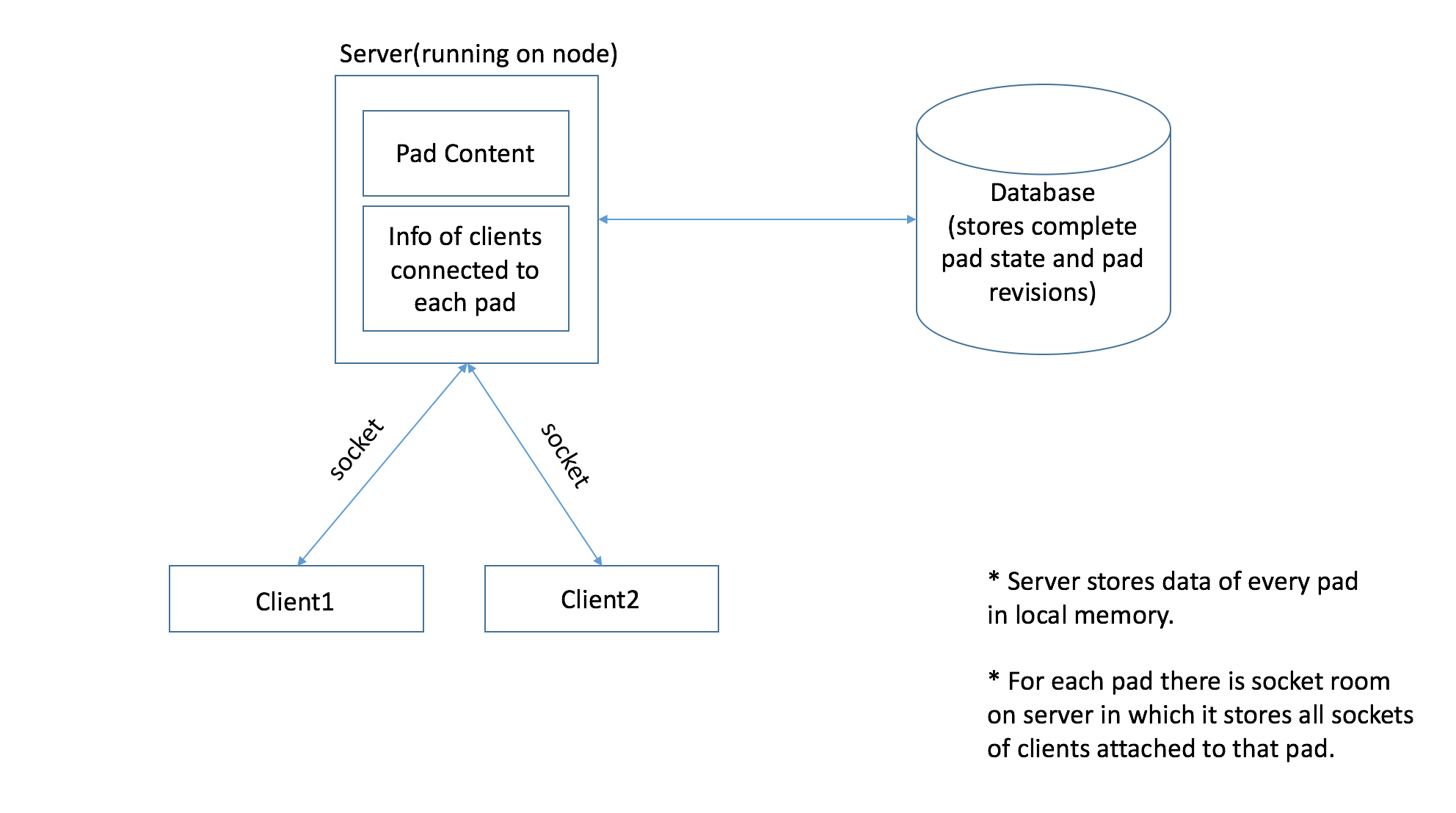
This time, there are at least three actors involved:
- Developers, who wrote Etherpad code
- Users, connecting from their browsers to a server
- And someone who needs to install, configure and keep running the Etherpad application on the server
Who exactly is #3? It could be a user, because it needs to use the software written by the developers in order to serve the users in #2. But it’s a special kind of user because it doesn’t need to write a document like the end-users in #2.
We have two categories of users, let’s call them End users and Server users.
The FSF has tried to address this issue by creating a new license in 2007, the Affero GPL to cover exactly this specific use case. The FSF says:
If you run a modified program on a server and let other users communicate with it there, your server must also allow them to download the source code corresponding to the modified version running there.
Problem solved? Not so fast.
Enter AI applications, think Apple Siri or Google Assistant. These applications are not that different from Etherpad: There are users communicating with a server and the server is connected to a database. But AI uses data to deliver meaningful answers. And data is not software in the sense of the free software definition.
Follow me for a minute: Let’s assume that Siri is powered by Mycroft, the open-source voice assistant. Now the Server Users of Mycroft software need to train Mycroft to recognize voices in multiple languages and give meaningful answers. They gather data, train their models and deliver services to the End Users on their phones. The whole software side of the machine is open source, but the data is not and that’s where the value is.
In this scenario the user is enslaved by data, not software. The free software definition fails to protect the largest class of ‘users’ of a computing device.
This isn’t an isolated use case, we could further explore the world of “serverless” computing or function-as-a-service. For example, this simple application that pulls health data from the Apple Watch to build charts. In this scenario, things are even more complex, with multiple actors involved for what looks like a simple computation but relies on a lot of different classes of computing machines that don’t look like a traditional server in any way, shape or form.
Why the need to define users now
Since the FSF was established, computers have changed and the world has moved on from New Coke, Nintendo NES and “We are the World.” The way software is run has changed. Applications have become tied to data they need in order to be useful. How to reconcile the mission of FSF to “promote computer user freedom” when computers and users have radically changed in 40 years?
This is the most important question for the future of the free software movement. The Board of the FSF explains they re-admitted Stallman because they missed his unrivaled “historical, legal and technical acumen on free software.”
To recover the lost time, I wish they recruit experts and community members, to define the concept of computer user and adapt the Free Software Definition to modernity. A new and reformed FSF could lead the conversation similarly to how it updated the GNU GPL to v3: a multi-stakeholder process to set the foundation for the next 20 years of freedom for citizens of a digital society.
@reed I’m not convinced that “user” is even the right word, but by insisting on “programmer, “administrator”, and “operator” over “user” I risk engaging in RMS-style pedantry.
@starbreaker I’m not advocating to use those terms. I’m using that argument to demonstrate how simplistic is the free software definition, inadequate to modern times
Stefano makes *very* good points. I believe he is right- we need to redefine 1) what software is, especially when most “software” is data in a ML model 2) who or what is the user?
This Article was mentioned on brid.gy
Richard Stallman and the FSF apologized for their actions. Good. Now they need to recover for a generation lost behind a world that doesn’t
Richard Stallman and the FSF apologized for their actions. Good. Now they need to recover for a generation lost behind a world that doesn’t
This Article was mentioned on brid.gy
This Article was mentioned on brid.gy
Richard Stallman and the FSF apologized for their actions. Good. Now they need to recover for a generation lost behind a world that doesn’t
Richard Stallman and the FSF apologized for their actions. Good. Now they need to recover for a generation lost behind a world that doesn’t
This Article was mentioned on brid.gy
Richard Stallman and the FSF apologized for their actions. Good. Now they need to recover for a generation lost behind a world that doesn’t
This Article was mentioned on brid.gy
This Article was mentioned on brid.gy
Well done, you raised important questions about how @fsf should consider moving ahead. Finally someone having something worth reading on the future of the Free Software Foundation.
Well done, you raised important questions about how @fsf should consider moving ahead. Finally someone having something worth reading on the future of the Free Software Foundation.
I think you’re tackling very similar topics with this piece as I talked about in my #StateOfTheSource talk: speaking.unlockopen.com/0fCCXZ
This Article was mentioned on brid.gy
Richard Stallman and the FSF apologized for their actions. Good. Now they need to recover for a generation lost behind a world that doesn’t
Did they? Some of the worst actions are not even mentioned.
Very valuable thoughts in there, thanks for sharing
Likewise.
This Article was mentioned on brid.gy
Me on the same general topics… almost fifteen years ago:
https://stop.zona-m.net/2006/11/a-free-software-manifesto-for-all-of-us/
https://stop.zona-m.net/2006/09/seven-things-were-tired-of-hearing-from-software-hackers/
This Article was mentioned on brid.gy
Richard Stallman and the FSF apologized for their actions. Good. Now they need to recover for a generation lost behind a world that doesn’t
This Article was mentioned on brid.gy
“I’m sorry you were punched” instead of “I’m sorry I punched you” is not an apology.
Richard Stallman and the FSF apologized for their actions. Good. Now they need to recover for a generation lost behind a world that doesn’t
Richard Stallman and the FSF apologized for their actions. Good. Now they need to recover for a generation lost behind a world that doesn’t
This Article was mentioned on brid.gy
Pingback: La mia opinione sul "casino" Stallman - Daniele Mte90 Scasciafratte
This Article was mentioned on brid.gy
This Article was mentioned on brid.gy
Pingback: [Article] The second liberation: AI is the final frontier of Copyleft – ][ Stefano Maffulli